
Book Preview
22 selected SAMPLE PREVIEW pages from the Parent & Educator Guide, Learner Workbook, and Answer Key with Reasoning. Swipe or scroll horizontally to browse.
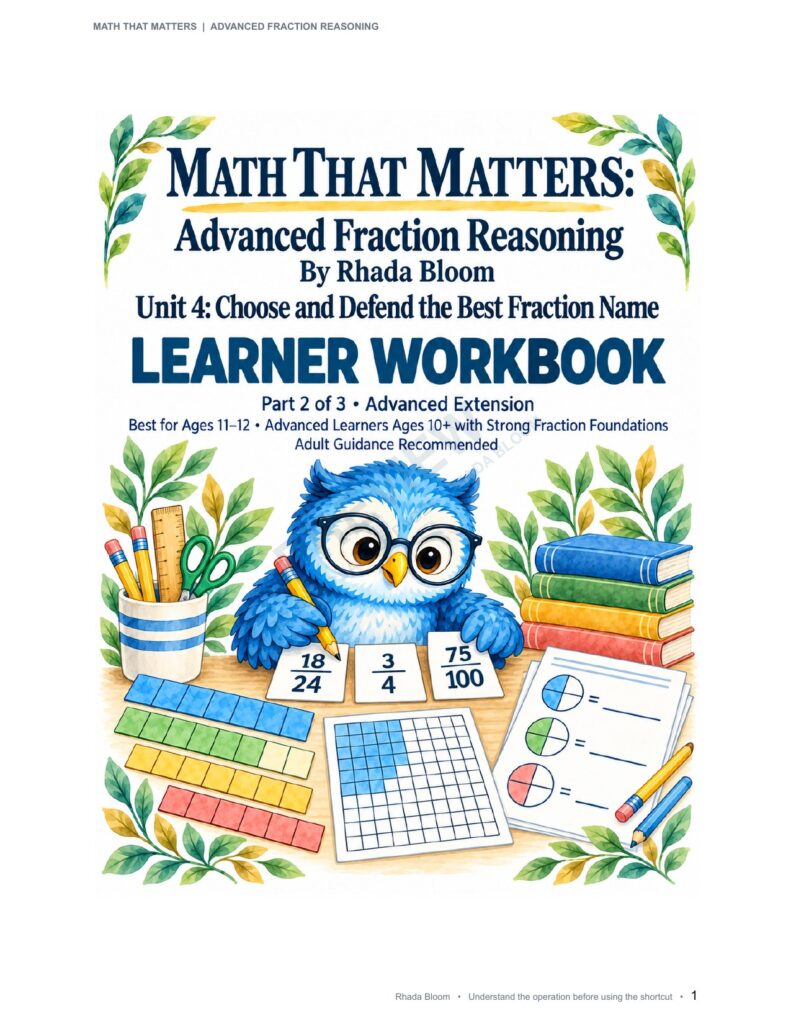
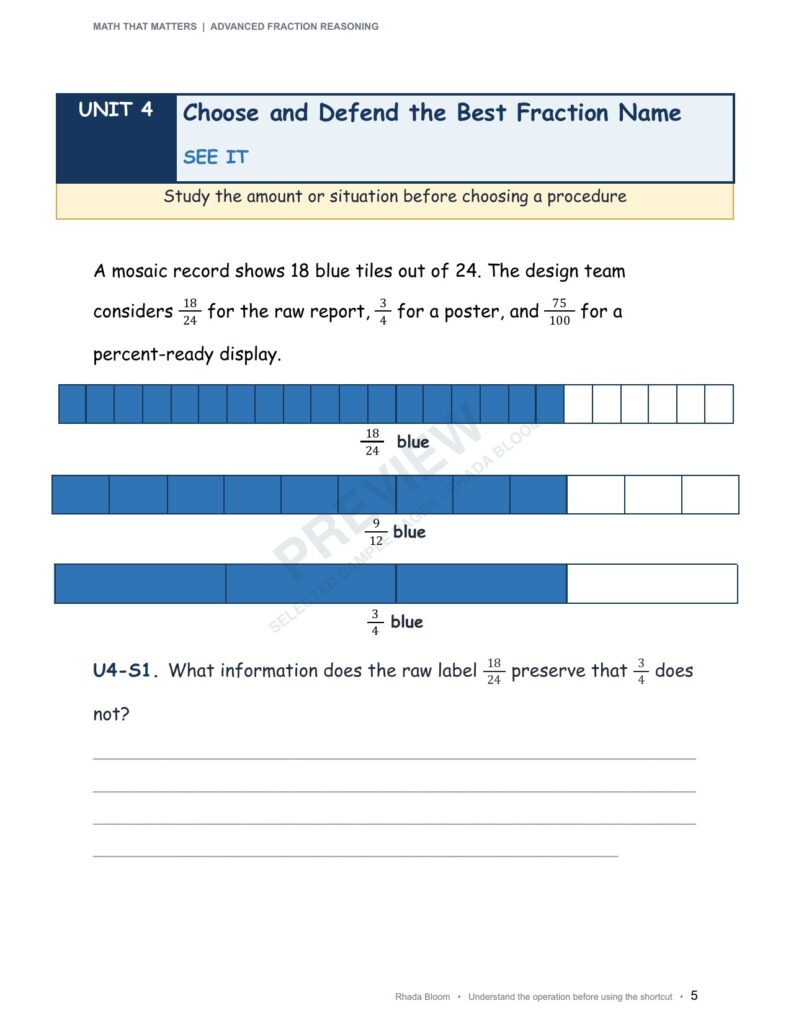
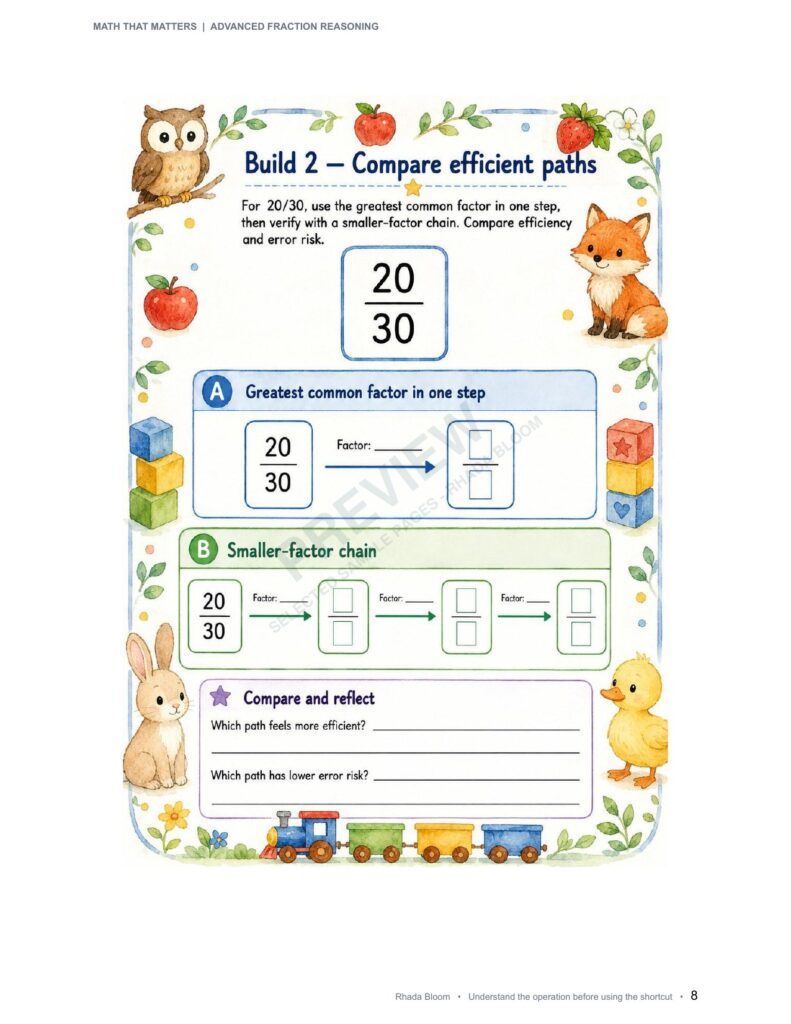
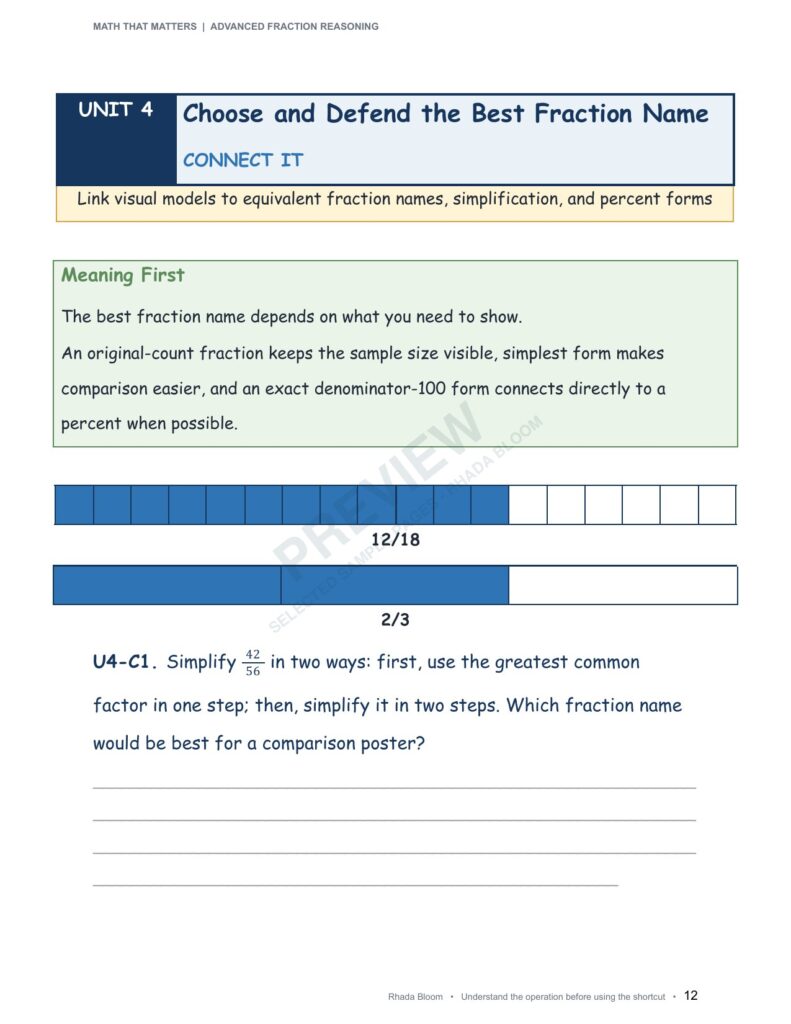
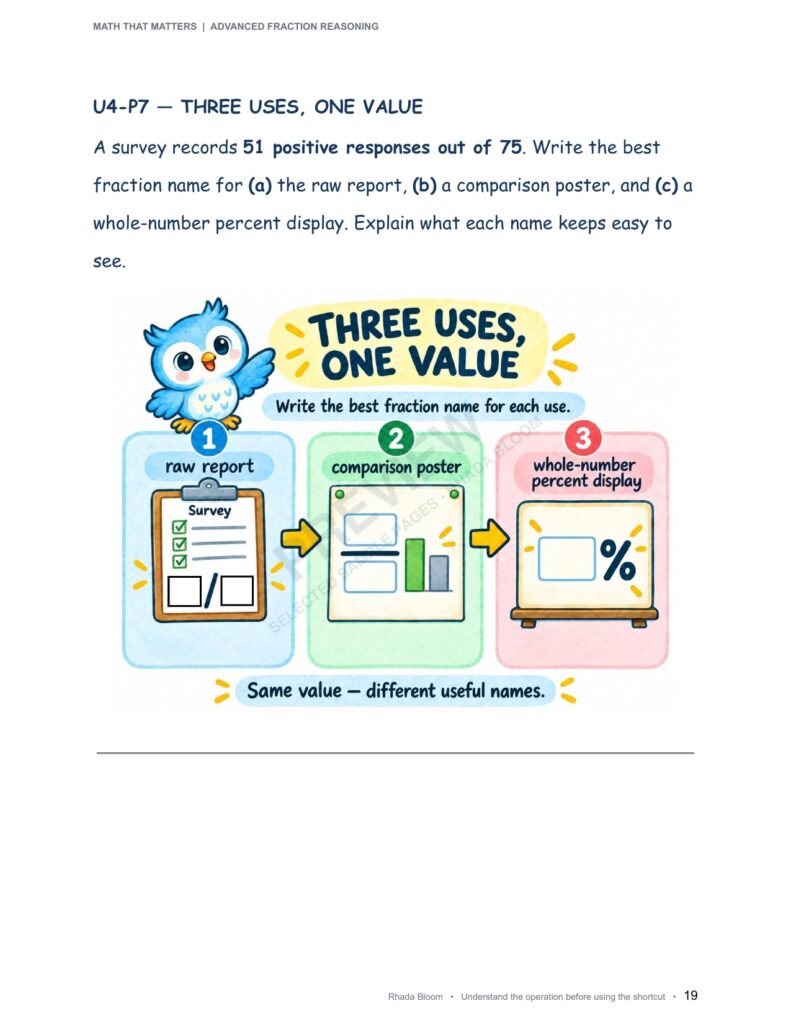
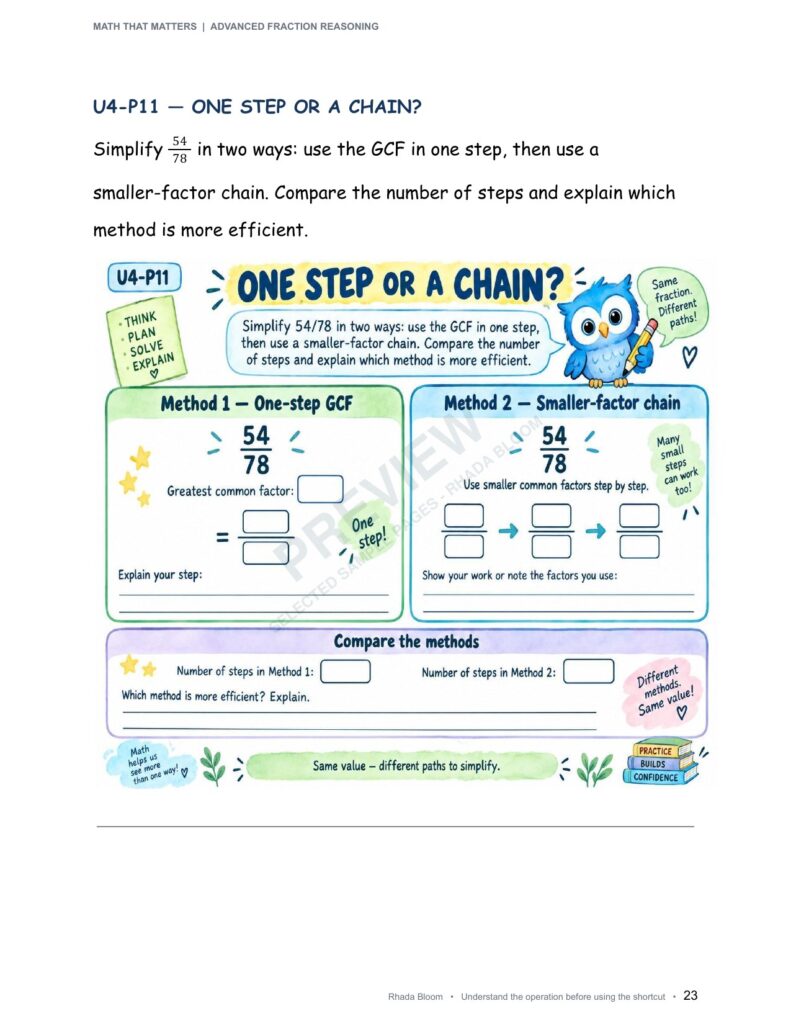
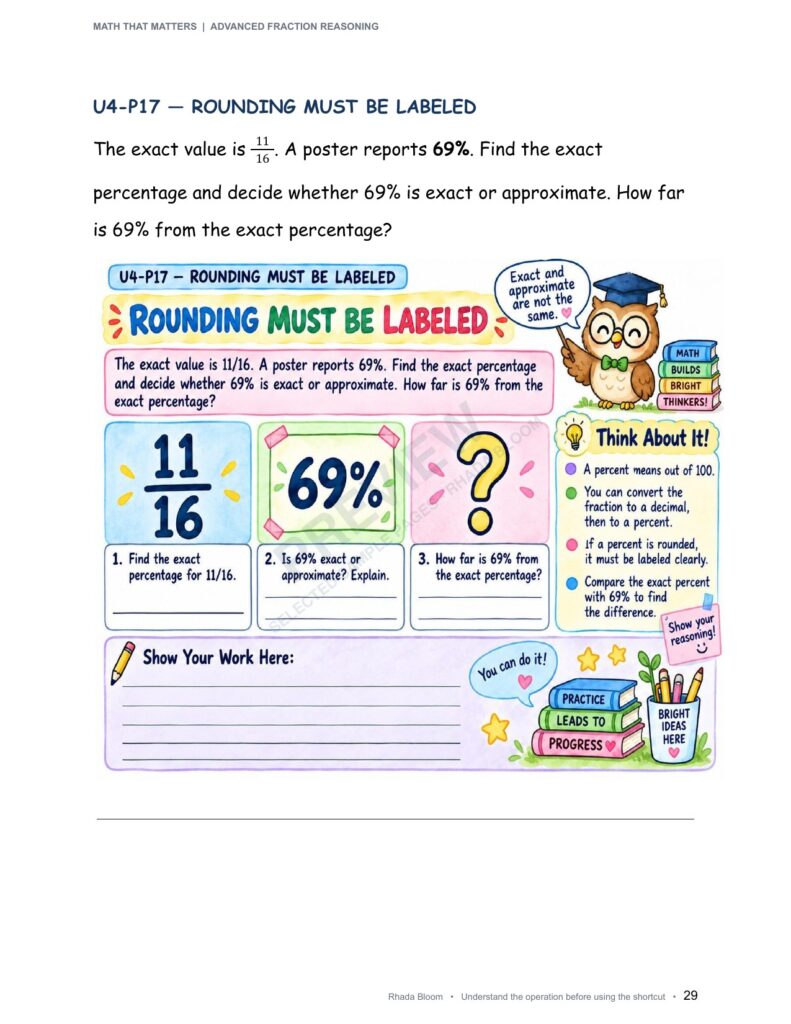
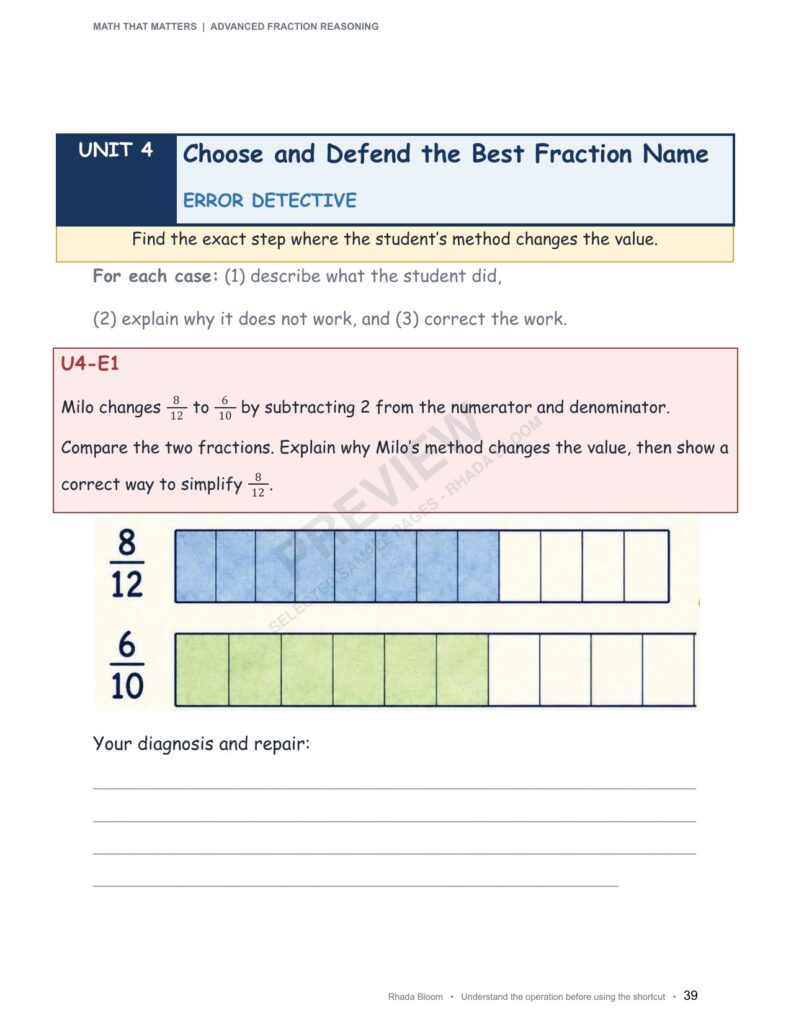
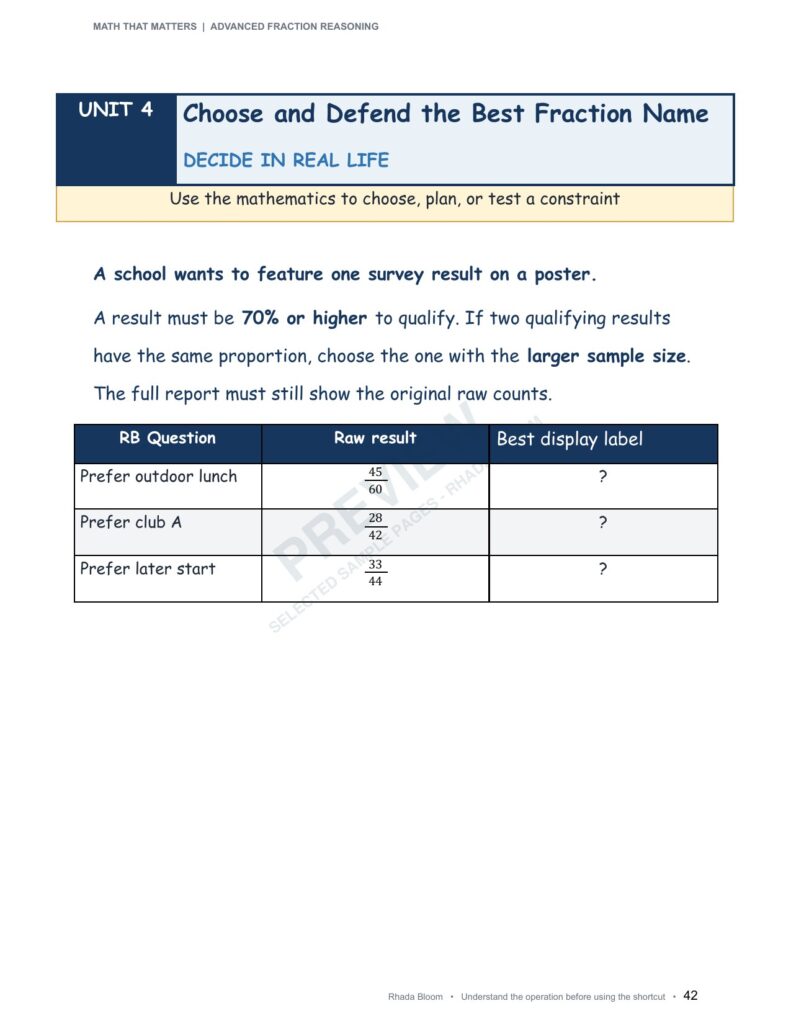
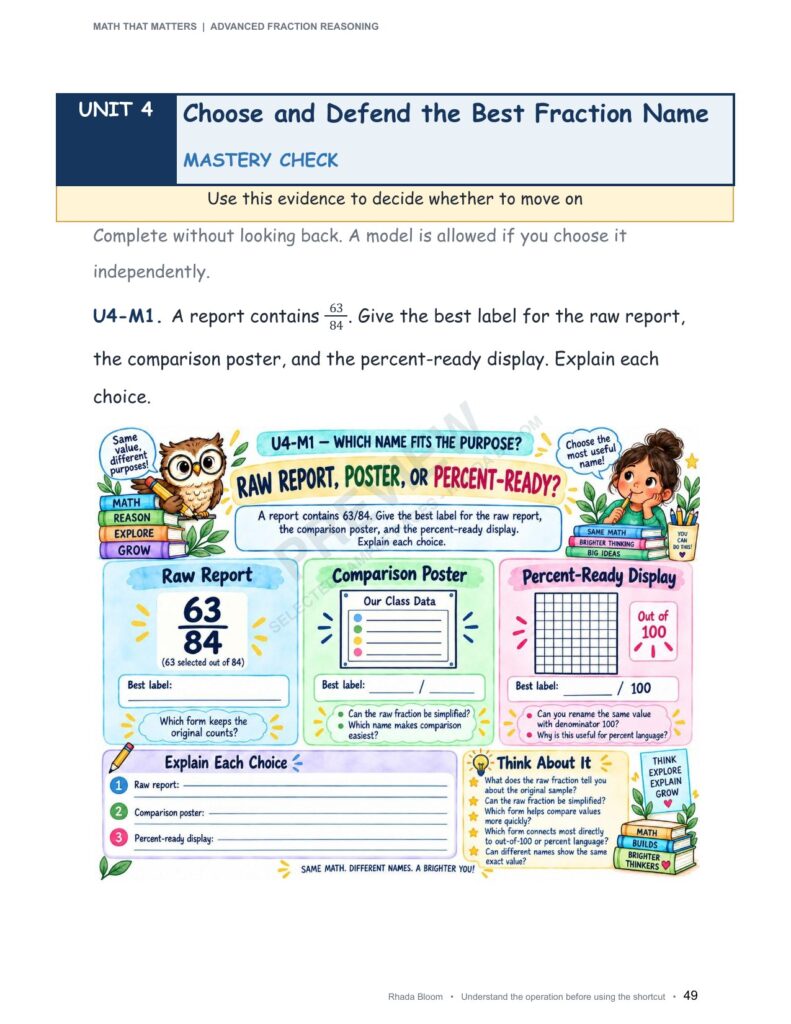
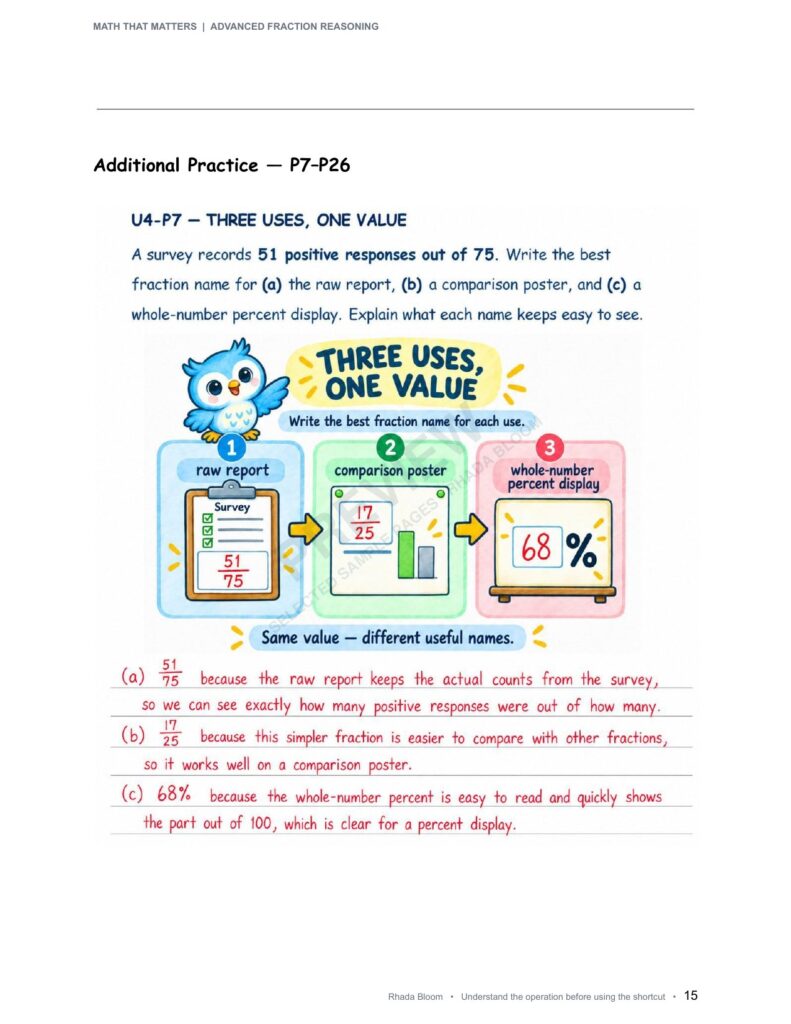
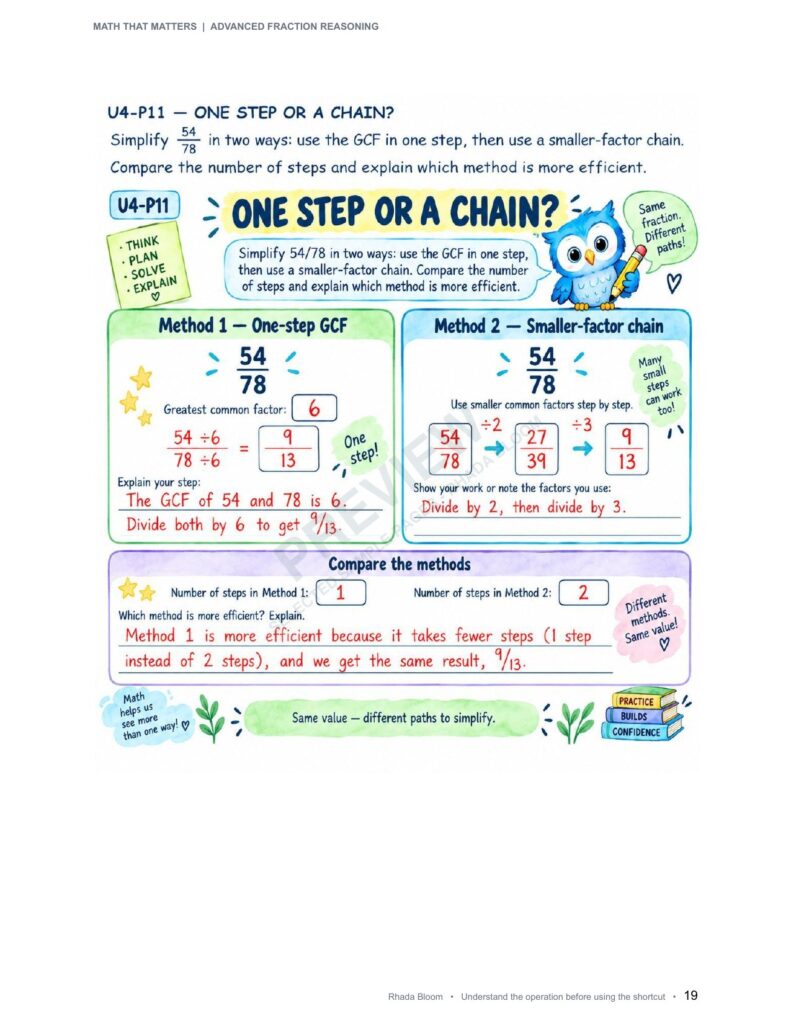
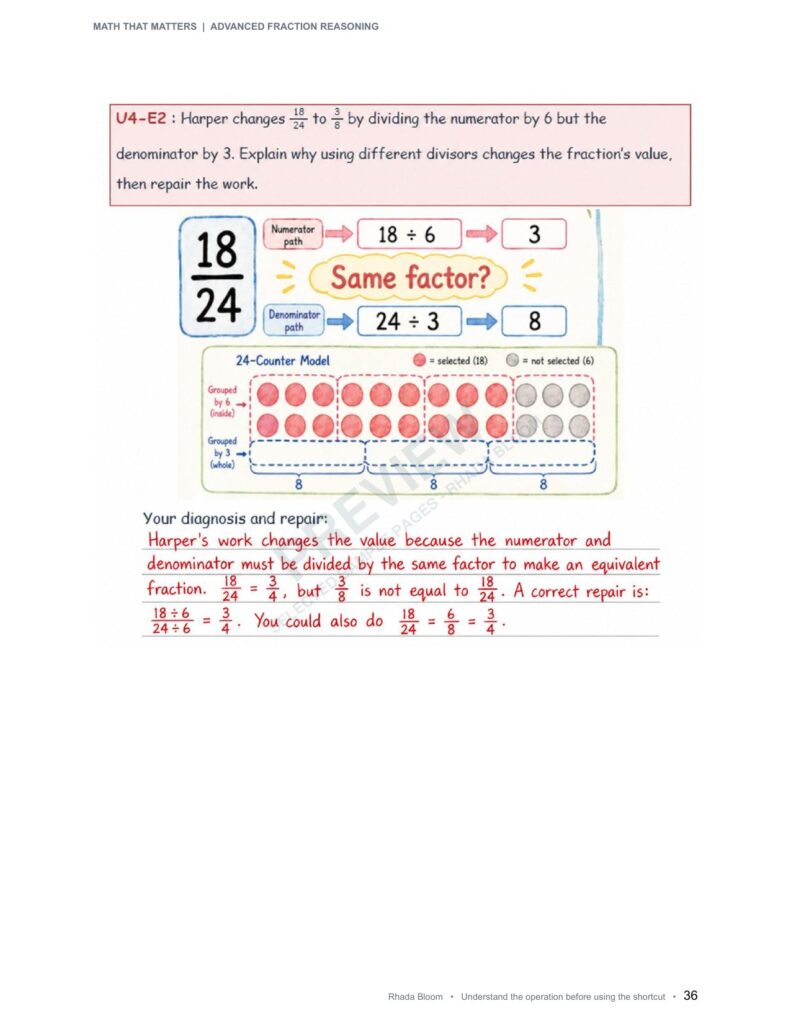
One fraction value can have several equivalent names—but the most useful name depends on what the learner needs to communicate.
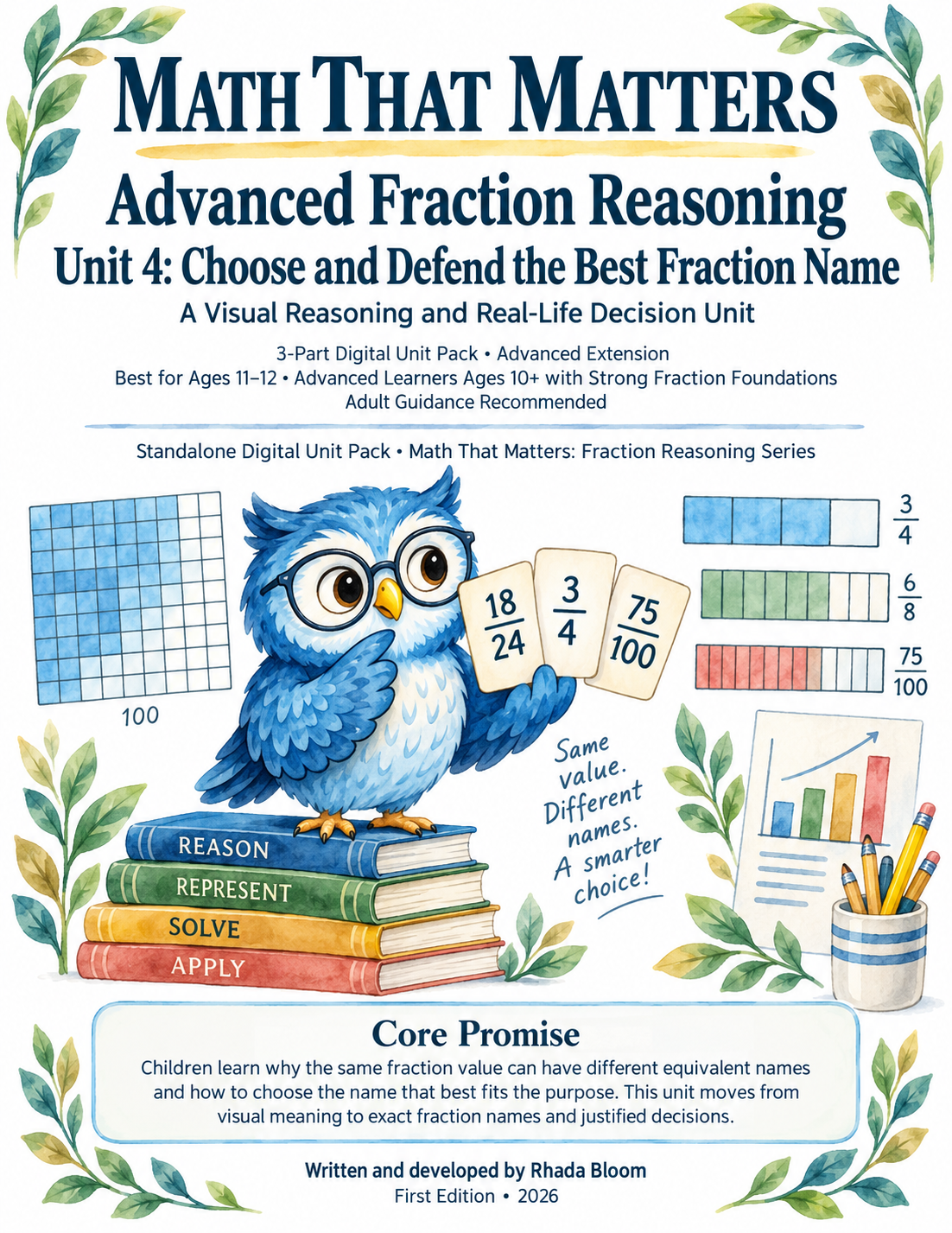
MATH THAT MATTERS: Advanced Fraction Reasoning — Unit 4 helps learners understand why a raw-count fraction, a fraction in simplest form, and a denominator-100 fraction can represent the same value while serving different purposes.
Learners move from visual models and fraction equivalence to simplification, exact and approximate percentages, error analysis, data checks, and real-life decisions. They are asked not only to calculate, but also to explain and defend why a particular fraction name is the best choice.
What You Will Receive
This digital unit includes 3 PDF files totaling 117 pages.
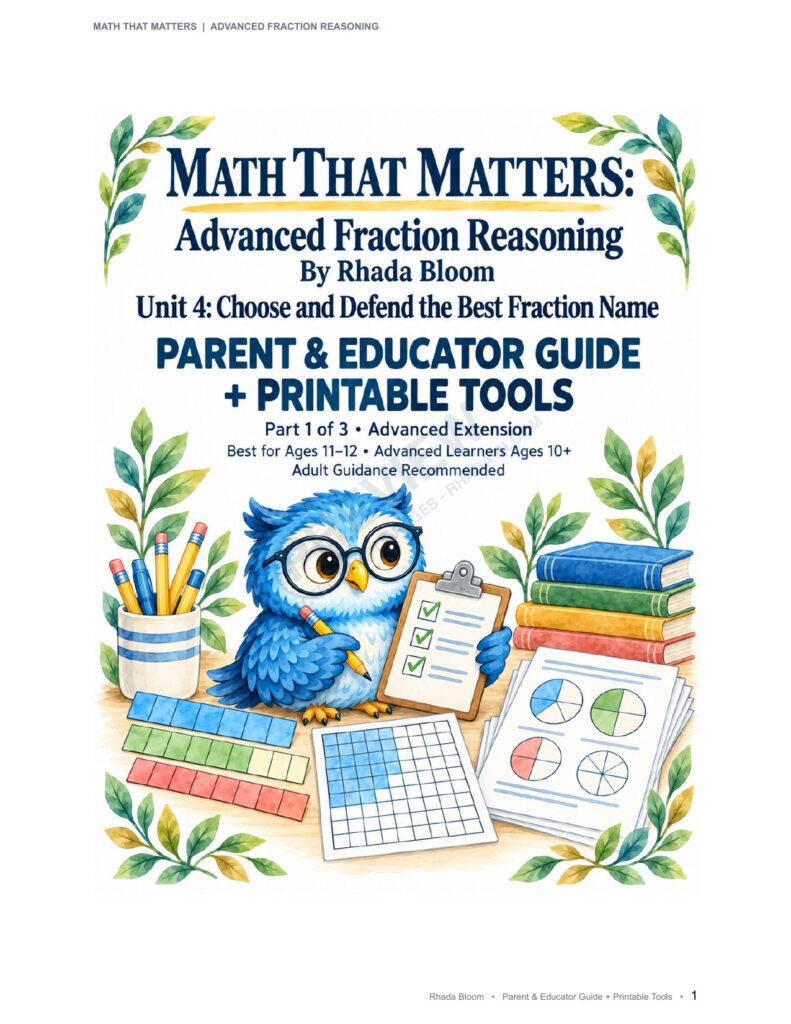
1. Parent & Educator Guide + Printable Tools — 17 Pages
A practical guide for preparing and teaching the unit.
Includes:
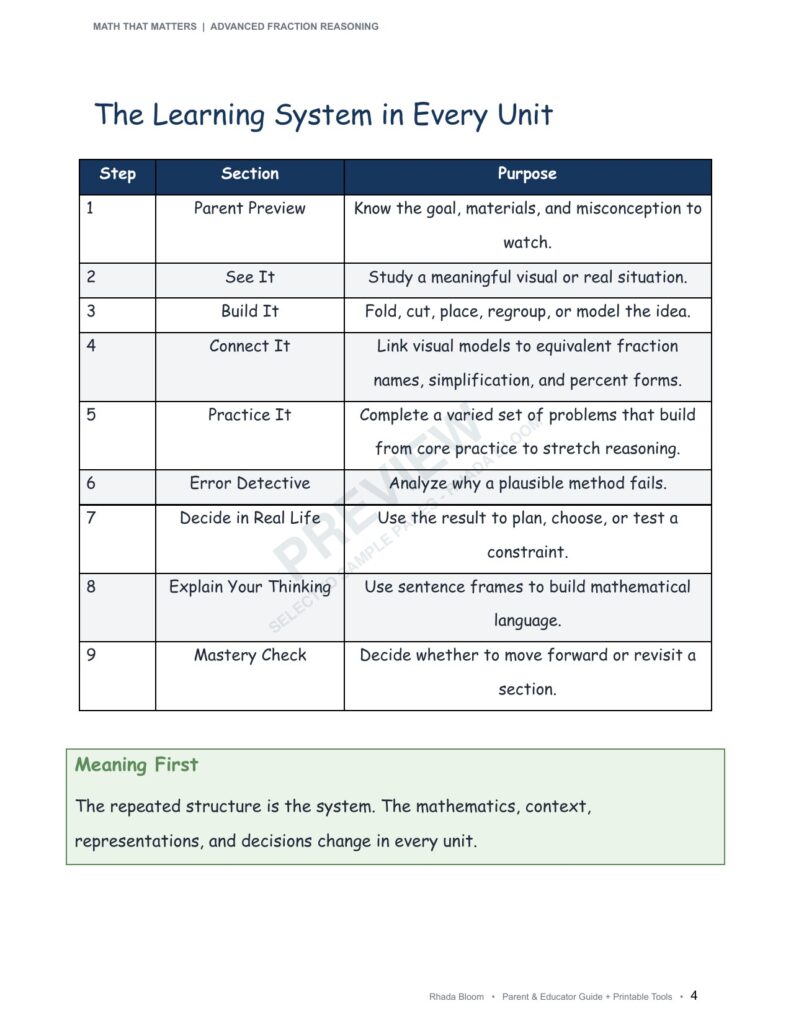
- An overview of the Meaning-First learning system
- Instructions for learners and adults
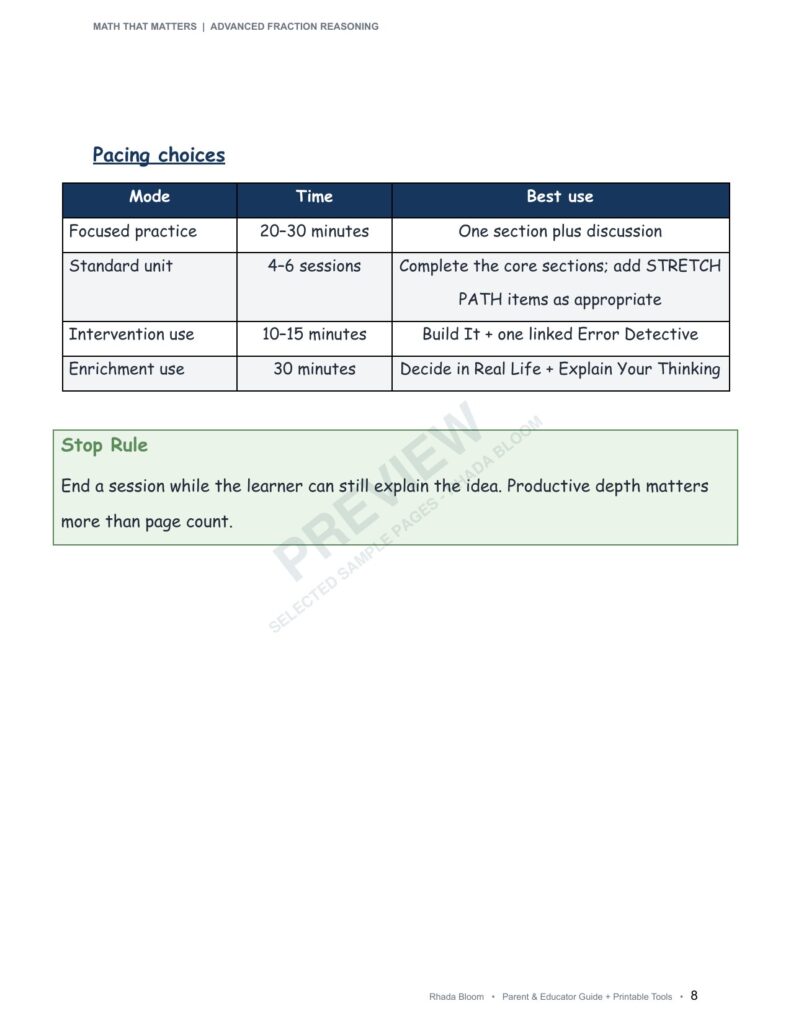
- Suggested pacing for 4–6 short sessions
- Focused Practice, Standard Unit, Intervention, and Enrichment pacing options
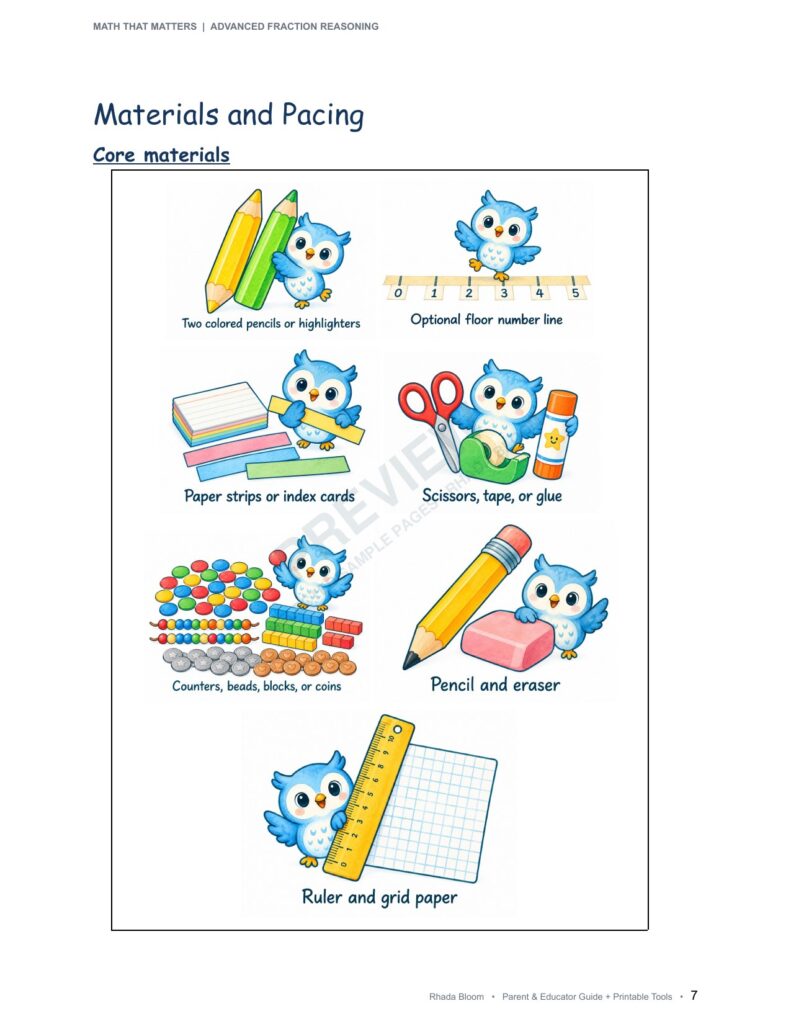
- Materials list
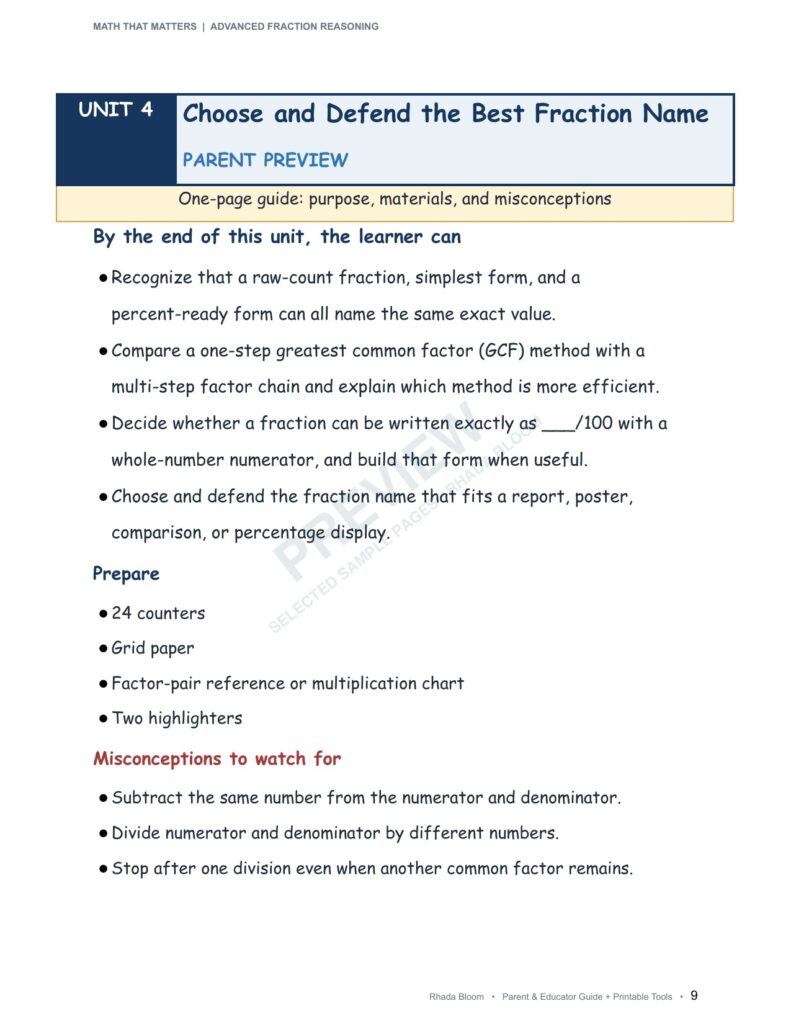
- Parent Preview
- Learning goals and misconceptions to watch for
- Printable fraction strips
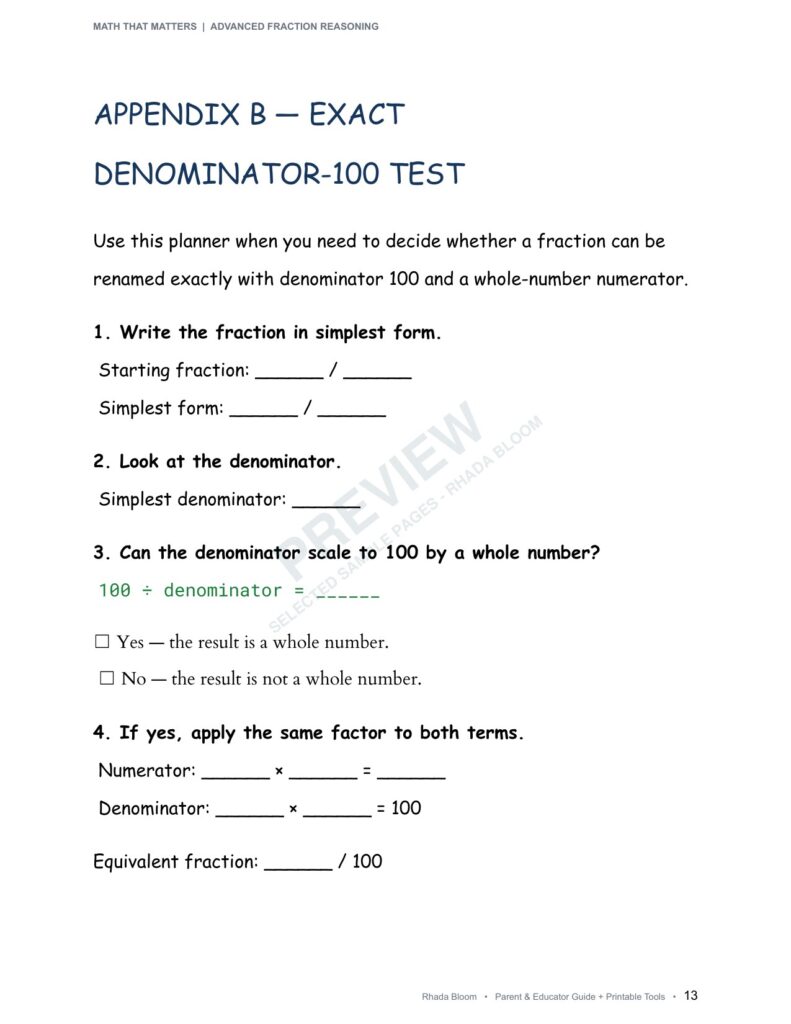
- Exact Denominator-100 Test
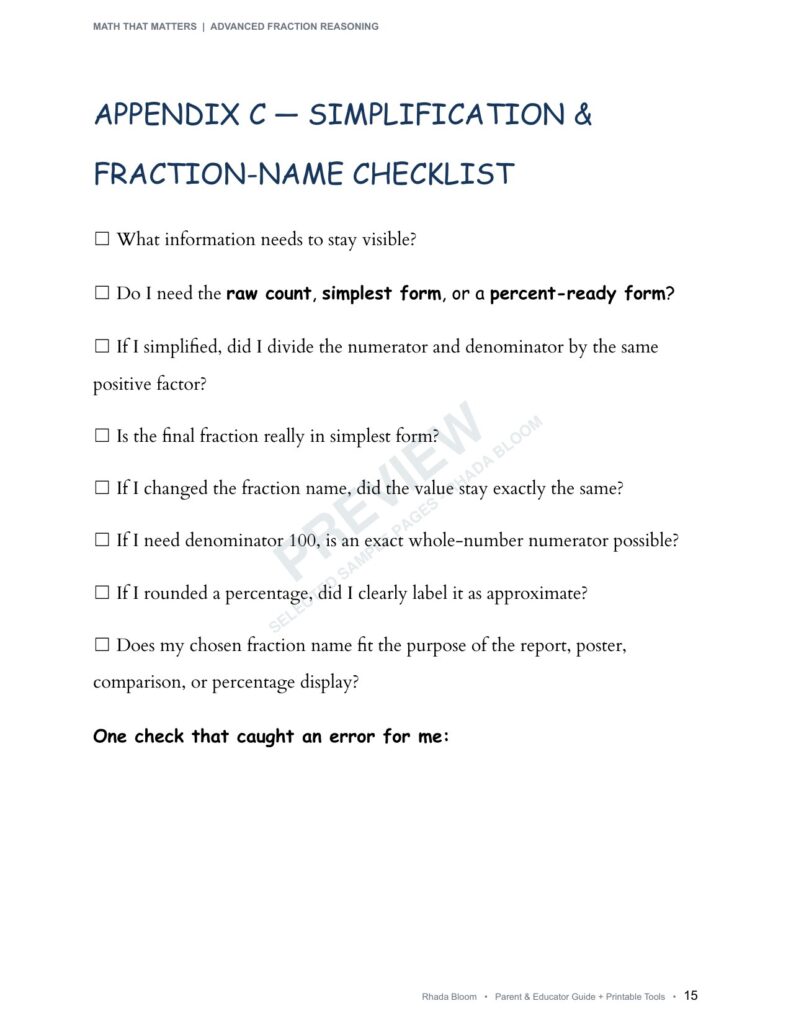
- Simplification and Fraction-Name Checklist
- Defend Your Fraction Name sentence frames and reasoning supports
2. Learner Workbook — 53 Pages
The learner pathway follows:
See It → Build It → Connect It → Practice It → Error Detective → Decide in Real Life → Explain Your Thinking → Mastery Check
The workbook includes:
- Visual fraction models and equivalent-fraction representations
- Guided See It, Build It, and Connect It sections
- Activities connecting raw counts, simplest form, and denominator-100 forms
- GCF and factor-chain simplification
- 26 varied Practice It problems
- Exact and approximate percent reasoning
- Questions about when an exact denominator-100 form is—or is not—possible
- Reverse reasoning and missing-sample-size problems
- Data-consistency checks
- Denominator and sample-size constraints
- Three Error Detective activities
- Three Decide in Real Life questions
- Two Explain Your Thinking tasks
- A five-question Mastery Check with next-step guidance
- Core practice followed by optional Stretch Path problems
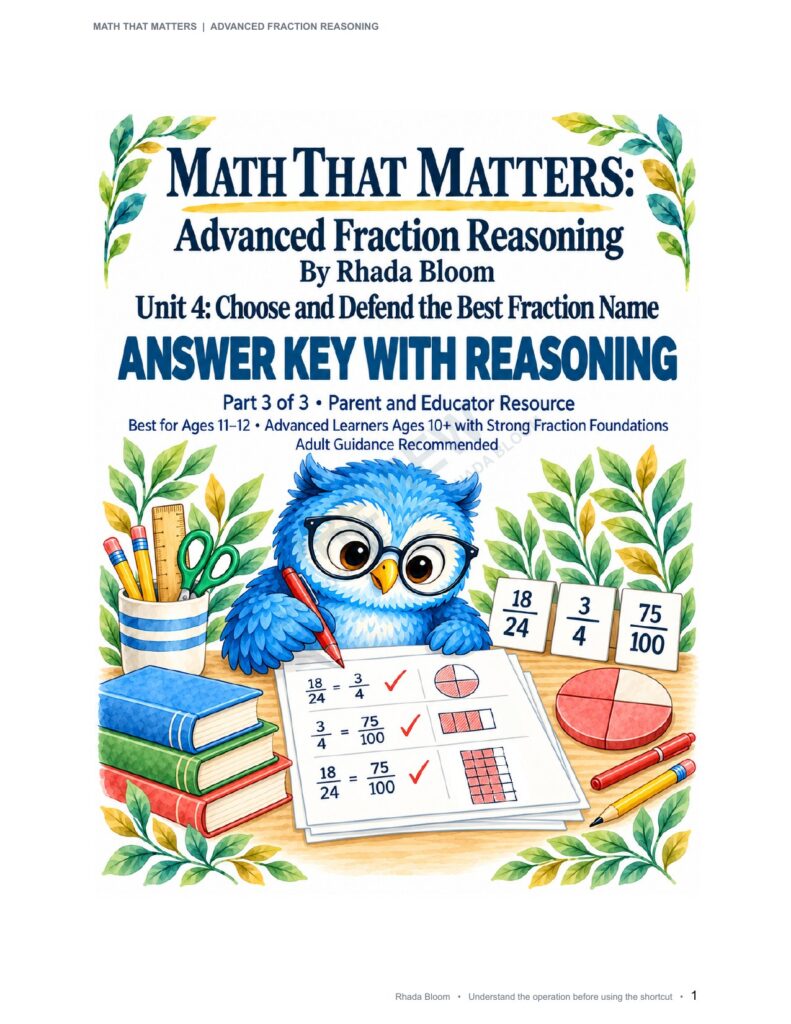
3. Answer Key with Reasoning — 47 Pages
A separate answer key for parents and educators.
Includes:
- Worked answers for See It, Build It, Connect It, and Practice It
- Answers for Practice It P1–P26
- Red-ink calculations and visual reasoning
- Error Detective corrections
- Decide in Real Life explanations
- Sample responses for open-ended questions
- Mastery Check answers
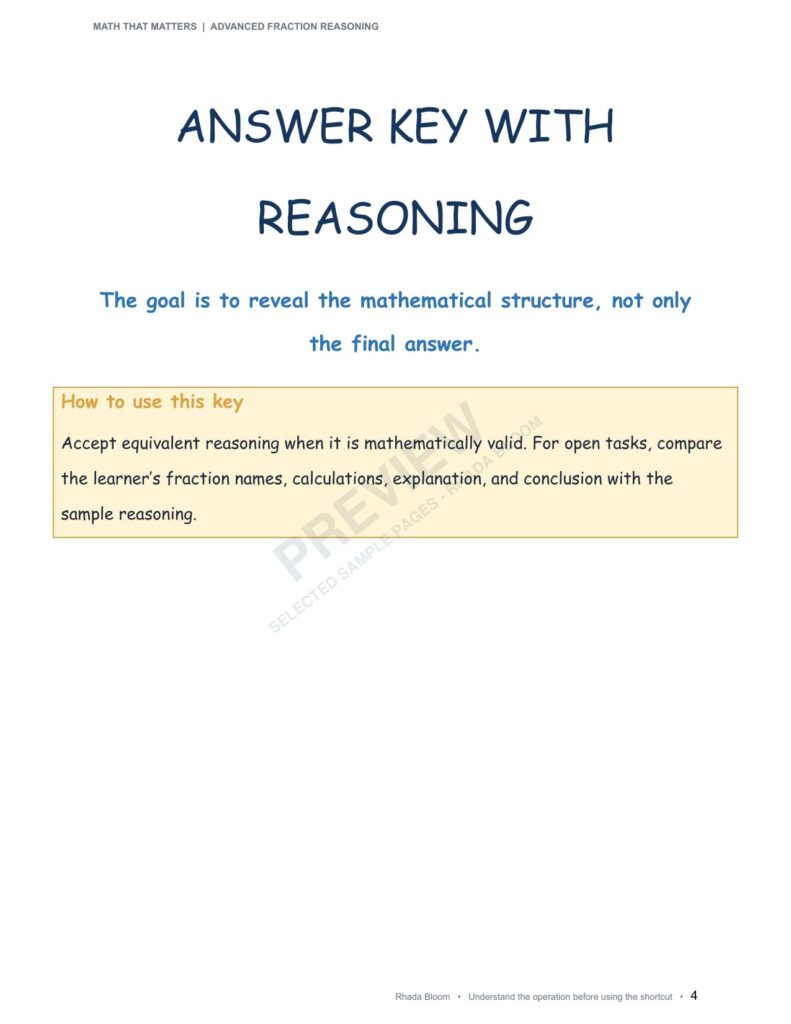
- Guidance for accepting mathematically valid alternative reasoning
This is more than a list of final answers. The key shows the mathematical structure and reasoning learners are expected to communicate.
Skills Developed
By the end of the unit, learners will practice how to:
- Recognize that equivalent fractions have the same value
- Preserve original sample information in a raw-count fraction
- Simplify fractions using a GCF or a chain of common factors
- Choose the clearest fraction name for comparison
- Determine whether a fraction can be renamed exactly with denominator 100
- Connect fractions to exact and approximate percentages
- Clearly label a rounded percentage as approximate
- Work backward from a simplified fraction or percentage
- Check whether raw data and a reported percentage are consistent
- Analyze incorrect reasoning and repair the mistake
- Explain and defend a mathematical decision
Who This Unit Is For
This unit is best suited for:
- Learners ages 11–12
- Advanced learners ages 10+ with strong fraction foundations
- Parents and homeschool educators
- Upper-elementary and early-middle-school enrichment
- Classroom educators seeking reasoning-centered fraction practice
- Learners ready to move beyond routine simplification
- Learners who benefit from visual models followed by written reasoning
Adult guidance is recommended.
Recommended Prerequisite Knowledge
Based on the tasks in this unit, learners should already be able to:
- Use multiplication and division facts with reasonable confidence
- Identify factors and common factors
- Generate simple equivalent fractions
- Simplify familiar fractions
- Understand that a fraction represents division
- Work with basic decimals or be ready to connect fractions with percentages
- Read and respond to multi-step mathematical questions
This Unit May Not Be the Right Fit For
This resource may not be a good fit for:
- A learner receiving a first introduction to fractions
- Most learners under age 10
- Learners who are not yet comfortable with multiplication and division
- Learners who still need foundational instruction in equal parts, numerators, and denominators
- Learners looking only for short computation drills
- Buyers seeking a workbook focused mainly on adding, subtracting, multiplying, or dividing fractions
- Younger learners expected to work completely independently
- Anyone seeking a complete introductory fraction curriculum
This is a standalone advanced unit, but it assumes a solid foundation in fractions.
Format
- 3 PDF files
- 117 total pages
- US Letter size: 8.5 × 11 inches
- Color PDF pages designed to remain readable when printed in grayscale
- For use within one household or one classroom by the original purchaser
- Digital download only
- No physical product will be shipped
MATH THAT MATTERS: Fraction Reasoning Series
RELEASE CONTEXT
Release activity around this project
Project Details
- Year
- 2026
- Audience
- Ages 11–12
- Format
- PDF - Digital Download
- Released
- 2026-09-22
- Available From
- Payhip ↗
View This Project
Available links for this project.