
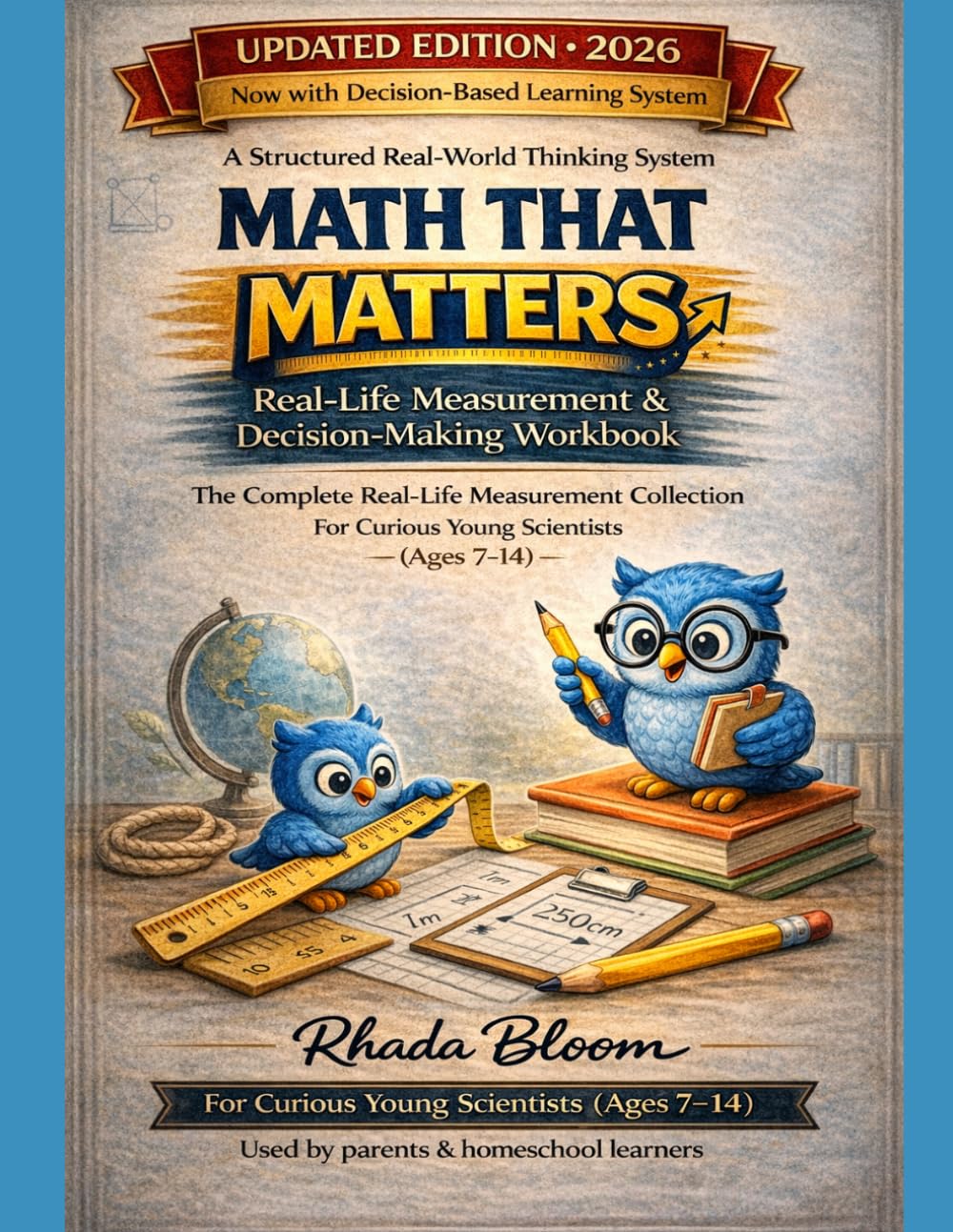
Hands-On Measurement Missions and Conversion Challenges for Curious Young Scientists (Ages 7–14)
Updated Edition — 2026
This revised edition introduces a structured learning system that guides learners from observation → measurement → calculation → real-world decision-making.It includes redesigned practice formats, decision-based exercises, and improved progression across all levels to support deeper understanding and independent thinking.Math That Matters: The Complete Real-Life Measurement Collection
Hands-On Measurement Missions and Conversion Challenges for Curious Young Scientists (Ages 7–14)
by Rhada BloomOne book. Real-world math. Built to be used, not finished.
Math rarely feels difficult in isolation.The difficulty appears when numbers leave the page—when a child needs to measure space, compare dimensions, or interpret size in a real context.The procedures are familiar, but the meaning is not.Most practice materials focus on repetition: more exercises, more drills, more memorization.
That approach can improve short-term performance—but it often fails to transfer.
When the situation changes, the understanding does not follow.This collection is built differently.
Instead of treating measurement, unit conversion, and area as separate skills, it organizes them into a continuous system of use.Learners move through a structured sequence:observe → measure → compare → decide
So mathematics becomes a tool for interpreting the world—not just completing tasks.Inside this complete system, learners will:
- Work with real, measurable objects—translating physical dimensions into understanding
- Convert fluently between metric and imperial systems (cm, m, inches, feet) with context—not guesswork
- Compare and evaluate dimensions across different units and real-world constraints
- Calculate area and interpret what it actually means in layout, design, and space use
- Develop estimation, reasoning, and explanation as part of the process—not as an afterthought
- Apply mathematics to everyday decisions where both accuracy and interpretation matter
Each section is built around clear examples, guided exercises, and familiar scenarios—including product sizing, room planning, print formats, and basic design contexts. The focus is not only on getting answers right, but on understanding:
– What does this number represent? – And can it actually be used? THIS IS A system.
This is designed for deliberate, cumulative learning—closer to how real understanding is formed, tested, and retained over time.This book is ideal for:
- Families seeking a long-term learning resource that grows with the learner (ages 7–14)
- Homeschool environments that prioritize applied understanding over repetition
- Students who can follow formulas—but struggle to apply them in unfamiliar situations
- Parents looking for structured, screen-free STEM learning without constant preparation
It may not be the right fit for:
- Test-focused practice or rapid problem drilling
- Advanced mathematics beyond foundational measurement, conversion, and applied geometry
– Ages 7–14
– Real-world measurement and applied math
– Structured progression across levels
– Designed for extended use over multiple years ** Optional online activities available at rhadabloom.com
RELEASE CONTEXT
Release activity around this project
Project Details
View This Project
Available links for this project.